Tag Archive: temporary van insurance

  1. What Type of Van Insurance Do You Need? A No-Nonsense Guide

    Comments Off on What Type of Van Insurance Do You Need? A No-Nonsense Guide

    Finding the right van insurance can feel like navigating a maze of terms, especially when you need to use your van for work. Do you need temporary van insurance, hire and reward van insurance, carriage of own goods van insurance, or something else entirely? The key to getting covered correctly and quickly is understanding one thing: your policy must match how you actually use the van.

    In the UK, van insurance is legally distinct from car insurance, even if you’re just borrowing a small van for the weekend. If the vehicle is classed as a van (often N1 or N2 on the V5C document), you need a specific van policy. Getting this wrong could leave your insurance invalid. This guide is here to help you compare temporary van insurance options, breaking down the different types of van insurance and explaining exactly which one you need, whether you’re moving house, commuting to a trade job, or delivering parcels.

    Van vs. Car Insurance: What’s the Key Difference?

    Vehicles classed as M1 (cars) require car insurance, while those classed as N1 or N2 (vans) require van insurance. This distinction, often determined by the manufacturer, reflects how the vehicle is built – primarily for carrying goods rather than passengers.

    Vans are often used for business purposes, transporting tools, equipment, or valuable goods, which presents a different, and generally higher, risk profile to insurers. According to Department for Transport estimates, van traffic increased by 9.5% between 2019 and 2024, showing a clear rise in commercial vehicle usage. A 2019-20 DfT van survey showed the most common primary use for licensed vans was for ‘carrying equipment, tools and materials’, with the second highest usage being courier work. 

    Because vans are generally higher risk due to their commercial use and larger size, they have different insurance needs. Policies can include specialised coverages that aren’t typically in a standard car policy, such as ‘Goods in Transit’ or higher liability limits due to their commercial role.

    Always check the vehicle’s classification. If it’s a van, you need van insurance. If you’re only borrowing a van for a short time, temporary van insurance can be a quick and flexible solution.

    Understanding Your Van’s “Class of Use”

    Insurers group van use into distinct “Classes of Use” groups.  It’s essential to pick the one that accurately describes all your driving, as choosing the wrong one could invalidate your cover. 

    1. Social, Domestic & Pleasure (SDP)

    This is purely for personal, non-business use.

    • What it covers: Everyday personal errands like shopping, visiting family and friends, going on holiday, or transporting your own things for personal use. This is ideal if you use the van like a large personal car for trips and day-to-day life.
    • What it doesn’t cover: Commuting to work or any business-related travel, including carrying tools or business equipment.

    Who needs it: Individuals who use their van instead of a car for private errands but never for work.

    2. Social, Domestic & Pleasure + Commuting

    Commuting adds cover for driving to and from a single, fixed place of work to the standard SDP uses. 

    • What it covers: Everything in SDP, plus the daily drive to and from one regular place of employment.
    • What it doesn’t cover: Carrying tools, equipment, or goods for work purposes, or travelling to multiple work sites, or places for work, like site visits or meetings.

    Who needs it: Someone who works in an office, factory, or other single location and uses their van solely for private use and the drive to and from that one workplace.

    3. SDP + Carriage of Own Goods

    Temporary carriage of own goods insurance is one of the most common van policies. It means you can transport equipment that you use for work, like tools. 

    • What it covers: All private use (SDP and Commuting), plus the use of the van to transport your own business equipment, tools, or materials. This is the van insurance you need if you need to transport tools to carry out your job.
    • What it doesn’t cover: Delivering other people’s goods in exchange for payment (hire and reward).

    Who needs it: Tradespeople like plumbers, builders, carpenters, or gardeners who carry their own supplies and tools between home, suppliers, and job sites. If you’re a tradesperson, you’ll need a policy like this.

    4. SDP + Carriage of Goods for Hire & Reward

    Temporary hire and reward insurance is for courier drivers who transport other people’s goods in exchange for payment. This is the necessary insurance for a commercial van driver involved in deliveries.

    • What it covers: Delivering parcels, food, or other items to multiple addresses for a fee, along with all SDP uses. This is typically split into two sub-categories:
    • What it doesn’t cover: Critically, the vehicle policy itself does not typically insure the value of the goods being carried. For that, you need Goods in Transit.
    • Who needs it: Food delivery drivers, parcel couriers, and removal companies. It’s the best way to get insured for delivery work

    Vehicle Cover vs. Cargo Cover: Goods in Transit Explained

    It’s vital to understand that your van insurance policy is separate from Goods in Transit (GIT) insurance, which covers the cargo. This is an essential distinction for both Carriage of Own Goods drivers and those with Carriage of Goods for Hire & Reward cover.

    • Carriage of Own Goods: This cover legally permits you to use your van to transport your own business tools or materials. However, it does not automatically cover the cost of replacing your expensive tools if they are stolen from the van. You often need to add a separate Tools in Transit or Van Contents policy add-on for that protection.
    • Carriage of Goods for Hire & Reward: This policy class legally permits you to drive your van while being paid to carry other people’s goods (e.g., parcels or food). It covers the van, the driver, and liability to others, but it does not cover the value of the customer’s items you are delivering.
    • Goods in Transit (GIT) Insurance (Cargo Cover): This is an additional policy that covers the value of the actual items being transported – whether they’re your own stock or a client’s parcels – against loss, theft, or damage while in your van. While your Hire & Reward policy covers the vehicle, the separate GIT policy is what protects the valuable goods you are carrying for others.

    GIT insurance is not a legal requirement, but it is standard for commercial operations and may be required by contract if you work for a large delivery company.

    What Van Insurance Do You Need For…

    Many of life’s situations are short-term, meaning you only need cover for a matter of hours or days. This is where the flexibility of temporary van insurance really comes into its own. If you’re still confused as to which type of insurance you might need, hopefully, some of these scenarios might help:

    Borrowing a Van for a Trip or Errand

    Need to borrow your mate’s van for a quick trip to IKEA, or for moving house? Perhaps you’re borrowing a van to move in together, borrowing a van to drive to a festival or weighing up IKEA van hire vs borrowing a van

    • Cover needed: You will generally need an SDP policy for the duration of the trip.
    • The solution: A short-term van insurance policy covering Social, Domestic & Pleasure use is the quickest and easiest way to get insured for just the time you need, without risking the van owner’s annual policy. This allows you to legally drive the borrowed van without making any permanent changes to the owner’s insurance.

    Using a Van for Trade Work

    You’re a carpenter, builder, or plumber picking up supplies and driving to two different jobs today, carrying all your own tools.

    • Cover needed: Carriage of own goods. Your tools and movement between multiple work sites mean you need a commercial policy.
    • The solution: If you’re using your own van, you’ll need an annual policy with carriage of own goods cover. If you borrow a van for a specific job, only occasionally use your van for this work, or need cover for an employee for a few days, temporary van insurance with carriage of own goods cover gives you the protection required for your trade.

    Delivery Work

    You’ve signed up for a few weeks of delivery shifts to earn extra cash, making multiple drops for a local food service.

    • Cover needed: Carriage of goods for hire & reward (courier insurance). The moment you accept payment for delivering something, you enter this class of use.
    • The solution: For temporary work, a short-term van hire and reward insurance policy covers you for the precise period of work, protecting you while you make those multiple drops.

    What Happens if You Choose the Wrong Policy?

    Choosing the wrong class of use can have serious consequences. For instance, using an SDP-only van for even occasional commuting could invalidate your policy if you need to make a claim. If you insured your van under an SDP policy but had an accident whilst making deliveries, your policy could be invalidated and you’d be liable for any claims. It’s important to think about how you use your van when taking out insurance. 

    If you realise you need to use a van but aren’t correctly insured, a temporary policy can keep you protected from just an hour up to 28 days.

    Get the Right Van Insurance in Minutes

    The most important thing is being completely honest about how you use your van, whether it’s for social use, carrying your own tools, or delivering goods for a fee. Getting the right class of use is the key to legal and valid cover.

    Temporary van insurance is a fast, flexible solution that ensures you only pay for the cover you need, whether that’s an hour to borrow a van for a furniture run or a week for seasonal delivery work. Plus, it also protects the van owner’s No Claims Discount.

    Get a quote in under 2 minutes and hit the road with confidence. Download our temporary insurance app to get a quote in just a few taps. 

    Similar articles you might like

    • The Best Way to Get Insured for Delivery Work

      Having the right insurance in place for delivery work is essential. Whether you’re picking up a few shifts in the

      Read more

    • Everything You Need to Know About Temporary Courier Insurance for Vans

      Considering a career in courier services? Are you a self-employed Amazon delivery driver? Or perhaps you’re feeding the nation and

      Read more

    • Borrowing a Van to Move In Together

      Moving in together is a big step – and a decision most couples don’t take lightly. With the cost of

      Read more

  2. The Best Way to Get Insured for Delivery Work

    Comments Off on The Best Way to Get Insured for Delivery Work

    Having the right insurance in place for delivery work is essential. Whether you’re picking up a few shifts in the run-up to Christmas or delivering parcels full-time, you’ll need the right insurance in place before getting behind the wheel. Delivery work might seem simple on the surface, but if you’re using a van to transport goods, standard van insurance won’t cut it.

    The right temporary van insurance can be a major help for getting cover in place for delivery shifts. Here’s everything you need to know about getting properly insured for courier, parcel, and food delivery work with hire and reward van insurance, and why we’re one of the fastest, easiest ways to get covered.

    Do Delivery Drivers Need Special Insurance?

    If you’re delivering goods in exchange for payment (even just a few hours a week), you’ll need hire and reward insurance in place. Standard van insurance, even if it’s labelled as ‘business use’, doesn’t cover this type of work. 

    Business use as part of a policy means it covers you if you’re driving to places for work outside of your usual commute. This doesn’t include making deliveries; you can find out more about when you need business use insurance in our guide. 

    Without the right hire and reward policy, you could risk having your insurance voided or being fined for driving uninsured. Most companies won’t allow you to carry out deliveries without being covered. You’ll need specific delivery insurance in place if you do anything involving delivering goods for money, including: 

    • Courier work – such as delivering parcels for services like Amazon, Evri, or DPD.
    • Multi-drop van driving – including supermarket or local shop deliveries.
    • Food delivery – if you’re delivering hot or cold food orders in a van.

    What Kind of Insurance Do You Need to Deliver Parcels or Food?

    Whatever type of courier work you’re doing, you’ll need an insurance policy that reflects the work you’re carrying out. We offer two flexible types of hire and reward cover. Ensure you select SDP + carriage of goods for hire & reward when selecting your vehicle usage in the quoting process. This means whether you’re delivering food or parcels, you’ll be comprehensively protected. You can find out more about the specific types of H&R cover we offer: 

    Why Temporary Van Insurance Works So Well for Delivery Drivers

    With our delivery insurance options, you can pay as you go. Get covered from just 1 hour up to 28 days at a time – ideal if you’re working on a short-term contract or picking up seasonal shifts over the Christmas rush. Rather than paying for courier insurance all year round with an annual policy, you can simply layer it on top of your regular van insurance whenever you’re going to be working. 

    This doesn’t just save you from being over-insured when you’re not working. It also means that if you get into an accident whilst working, you’d claim under your temporary policy. Protecting your no-claims discount on any other policies you have. 

    Our delivery insurance for van drivers means you can:

    • Get insured in minutes – there are no long forms to fill out or phone calls.
    • Choose your own hours – with hourly, daily and monthly cover available.
    • Avoid affecting your annual no-claims bonus – because our policies run separately from existing annual insurance policies.
    • Only pay for the cover you need – perfect for ad hoc shift patterns. 

    If you’re using your van to deliver for businesses like Amazon, Just Eat, or Deliveroo, we can help you stay covered without having to commit to a year-long policy.

    How to Get Delivery Insurance Quickly

    Speed matters when you’re accepting last-minute shifts or filling in for someone. We’ve made it easier than ever to get insured instantly for delivery work with our new temporary insurance app. Even without the app, you can get covered in under two minutes online. Get a quote today to see just how quickly you can get comprehensive cover in place for your next shift.

    Make Sure You’re Covered Before You Deliver

    If you’re using a van for delivery work this festive season, make sure you’re properly insured. Hire and reward insurance is a legal requirement – and we make it simple to get covered for as long as you need, whenever you need it.

    Whether you’re delivering parcels, food, or picking up courier shifts between jobs, temporary hire and reward insurance helps you to stay protected, road legal, and ready to earn – without the faff.

    Similar articles you might like

    • The Best Way to Get Insured for Delivery Work

      Having the right insurance in place for delivery work is essential. Whether you’re picking up a few shifts in the

      Read more

    • Everything You Need to Know About Temporary Courier Insurance for Vans

      Considering a career in courier services? Are you a self-employed Amazon delivery driver? Or perhaps you’re feeding the nation and

      Read more

    • Borrowing a Van to Move In Together

      Moving in together is a big step – and a decision most couples don’t take lightly. With the cost of

      Read more

  3. Everything You Need to Know About Temporary Courier Insurance for Vans

    Comments Off on Everything You Need to Know About Temporary Courier Insurance for Vans

    Considering a career in courier services? Are you a self-employed Amazon delivery driver? Or perhaps you’re feeding the nation and transporting food door to door. Did you know that to courier, you can’t just use your regular old van insurance – you need a specific courier insurance, known in the insurance world as ‘cover for hire and reward’.. Luckily, our fully comprehensive temporary courier cover has been tailor-made to whisk you from A to B, and allows you to only pay for this extra cover when you actually need it for jobs. 

    We understand the certain pain points and struggles in the courier industry and that’s why our brand new specialised insurance offering is curated to meet the specific requirements to get you out on the road, hassle-free. Whether you’re in the business of delivering parcels or transporting food, behind the wheel of a car or van, our policy has you covered for vehicles of up to 7.5 tonnes. 

    And just like our temporary car insurance and temporary van insurance, you know you can get covered in under two mins, perfect for last minute jobs that drop in!

    What is Courier Van Insurance?

    If you’re considering moving into courier work, you might be wondering “What van insurance do I need for courier work?” The answer is temporary courier van insurance –  often referred to as ‘hire and reward’ insurance, it stands as a specialised form of cover tailored specifically for individuals or businesses involved in making deliveries for work.

    Courier van insurance is structured as a comprehensive package, covering the unique risks and requirements associated with local and frequent courier deliveries. This type of insurance is essential for individuals that receive compensation for deliveries, providing crucial protection that needs to be in place when using a vehicle for deliveries. With its focus on hire and reward activities, temporary courier van insurance offers a tailored and flexible solution to ensure that you’re covered during shifts, minus the obligation of a long-term insurance commitment. You can simply take out a temporary insurance policy for a day if you know you will only be couriering for one day, saving you unnecessary extra costs all year long.

    How Much is Courier Insurance?

    Like with all insurance policies, the cost of your temporary courier cover will depend on specifics about your vehicle, yourself and the duration of policy you require. By using our van insurance calculator you can get a sense for the average price of van insurance. To get an exact price for temporary courier insurance, go through our quick and easy quoting process – to get an exact price in under two minutes!

    Who Our Temporary Courier Insurance Covers?

    Our temporary insurance for couriers covers those using their vehicle for ‘hire and reward’ uses. You and your vehicle should meet the below criteria to be able to get courier insurance from us.

    • Commercial Vehicle – driver aged 19 to 75
    • Have a current permanent address as stated throughout the application (please note you may be asked to provide proof of residence in the event of a claim)
    • Has not ever been refused insurance, had a policy cancelled or voided
    • No driving ban in the last 60 months
    • No conviction for any criminal offence or any possible prosecution pending
    • Vehicle weight up to 7.5 tonnes
    • Minimum value Vans: £1* subject to age restrictions
    • Maximum value Vans: £65,000
    • Foreign use is not permitted
    • Not for exporting – journeys must start and end in the UK
    • Is not imported or left-hand drive and not modified (factory fitted extras or modifications for a disabled driver or passenger, or LPG conversions are acceptable).
    • Has no more than 7 seats and is not a rental or hire vehicle (if commercial – no more than 5 seats)

    What Our Temporary Courier Insurance Covers

    Temporary van courier cover offers a fully comprehensive solution that caters to the diverse needs of courier professionals. Whether it’s protecting against vehicle damages, liability issues, or unforeseen incidents during deliveries, our insurance cover is designed to offer peace of mind and security, allowing you to focus on the task at hand – delivering packages efficiently and securely.

    Flexibility is the cornerstone of our temporary insurance offering. We always want to allow our users secure cover precisely when you need it, for the duration you require.

    The temporary element of all our policies is particularly beneficial within the fast-paced environment of courier services, where schedules can vary and opportunities can arise at a moment’s notice. Our temporary courier insurance incorporates this flexibility, enabling courier professionals to take on diverse delivery tasks without the concerns of endless paperwork or needless back and forth between user and provider. It is always simple, hassle free and quick to get the cover you need with us.

    Whether you obtained your licence here in the UK or somewhere else in Europe, you can get courier insurance from us. Get ready to cruise down the carriageways worry-free as we guarantee cover for both licences – you just need to have been a UK resident for the past 12 months.

    Why GoShorty for Courier Cover?

    Understanding the diverse requirements of the insurance industry is what we do. Our temporary van courier cover provides a fix for drivers in need of reliable and affordable courier insurance that they can pick up, and put down, as and when they need it.

    Whether you take on the occasional weekend shift to top up the 9-5, or you’re regularly navigating the British roads like Santa on wheels, our flexible policy ensures that you’re able to find the perfect fit for your needs. Making our cover the perfect insurance for couriers in the UK.

    Like the majority of our available insurance plans, you’re receiving fully comprehensive cover, meaning should the very worst happen whilst you’re out, you can rest assured that your vehicle is fully protected, minimising any potential disruption or financial burden.

    The temporary and flexible nature of our policies mean you can take out a courier insurance policy exactly when you need it. Find van insurance for an hour, daily van insurance, weekly van insurance or monthly van cover for when you know you will be doing lots of courier shifts.

    Getting On The Road with Courier Van Insurance

    We know the courier lifestyle can be pretty rock ‘n’ roll – work can come up spontaneously, and for varying lengths of time, that’s why we take the drama out of the delivering, so you can do what you do best.

    We help you avoid any nasty surprises with this fully comprehensive offering; including getting halfway down the M4 only to see blue flashing lights in your mirrors! It’s no secret that temporary insurance can come with its issues and if your provider doesn’t update MID (Motor Insurance Database) frequently, then the police might think your vehicle is uninsured – which is a serious offence.

    Luckily, we update the MID four times a day, every single day, ensuring you never have any insurance-related troubles whilst on the road. This helps us, help you, get out and about without the worry of unwanted interruptions.

    The Benefits of Temporary Courier Insurance

    Temporary courier insurance is here for you, ensuring you’re covered when you need it, no strings attached.

    Flexibility is the name of the game! With us, you can secure cover specifically for those quick delivery runs or time-bound assignments, without the need to commit to long-term insurance contracts that might tie you down. Juggle those courier shifts with ease, knowing you’re covered every step of the way, no matter how unpredictable your schedule gets.

    Plus, you can wave goodbye to hefty insurance plans that eat into your hard-earned profits, too.

    And here’s the best part – we’ve made the whole process a breeze. No lengthy paperwork or confusing loopholes. With an easy-peasy application process that’s as quick as your speedy courier runs (remaining within the national speed limit, naturally) – you can get back to business after a momentary pitstop. Our quick and easy quoting process takes under two minutes.

    Gearing up for exciting transport adventures? Remember that GoShorty’s temporary courier insurance is ready to support you every step of the way. Get a quote today.

    Temporary Courier Insurance FAQs

    What does courier insurance mean?

    Courier insurance means your vehicle is insured for carrying out couriering services. Also known as hire and reward insurance, courier insurance allows you to make deliveries, parcels and food alike. The fully comprehensive courier insurance we offer means your vehicle and the goods you are delivering are fully protected whilst you are out making deliveries.

    Is hire and reward insurance the same as courier insurance?

    Yes, courier insurance is the same as hire and reward insurance. It is a type of cover for people who are using their vehicles to make deliveries, carrying parcels and making multiple delivery stop-offs throughout their day.

    Will courier insurance protect the goods I am carrying?

    No. Our policies which include cover for the carriage of goods for hire and reward do not include cover for the goods that you are carrying. With these policies you are insured to use the vehicle to carry goods for hire and reward, such as for food or parcel deliveries, but the items that you’re carrying are not covered by the policy.

    Not found the answer you’re looking for? Either get in touch or checkout our other FAQs

    Similar articles you might like

    • The Best Way to Get Insured for Delivery Work

      Having the right insurance in place for delivery work is essential. Whether you’re picking up a few shifts in the

      Read more

    • Everything You Need to Know About Temporary Courier Insurance for Vans

      Considering a career in courier services? Are you a self-employed Amazon delivery driver? Or perhaps you’re feeding the nation and

      Read more

    • Borrowing a Van to Move In Together

      Moving in together is a big step – and a decision most couples don’t take lightly. With the cost of

      Read more

  4. Borrowing a Van to Move In Together

    Comments Off on Borrowing a Van to Move In Together

    Moving in together is a big step – and a decision most couples don’t take lightly. With the cost of living crisis, spiralling rent and – of course – the desire to be together 24/7, plenty of couples are taking the plunge and making the move in 2023. 

    The cost of hiring a moving company or renting a van is certain to tarnish an otherwise exciting occasion – you’ve already got your rent and bills to worry about! Choosing to borrow a van and insure it for a day will save you some all-important cash – and maybe even mean you can splash out on your first takeaway together in your new home!

    How Long Should You Date Before Moving in Together?

    We wanted to dig a little deeper into the UK’s opinions on when the perfect time to move in with your significant other is, so we polled the nation’s couples* to uncover the precise moment you should pack up your belongings, borrow a van and move in with your partner. 

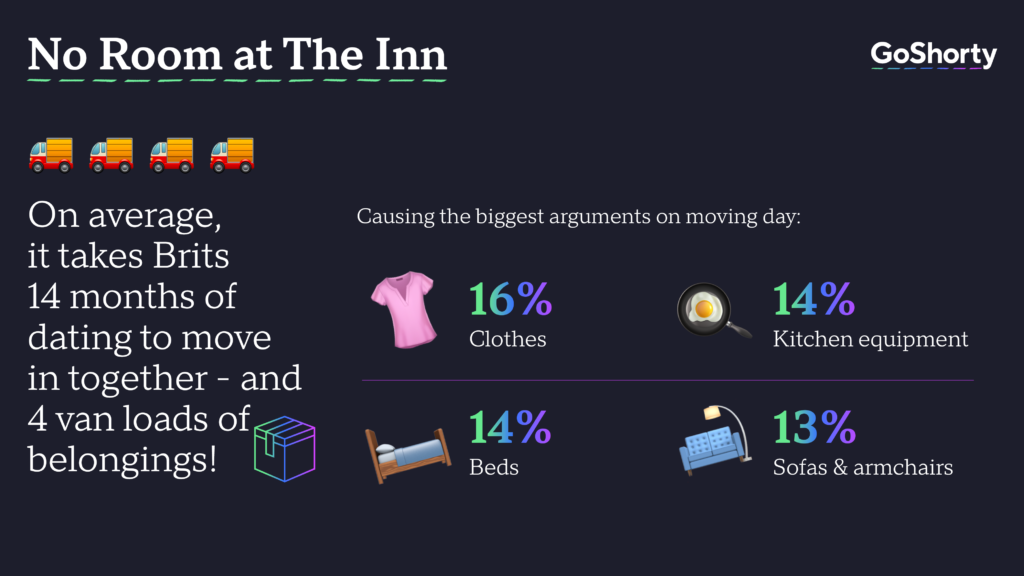
    After reviewing the data, we found that Brits consider 14 months to be the optimum amount of time to have dated before cohabitating.

    Three quarters (72%) of Brits think you need to take time to make sure that you are really with “the one” before you pool all your belongings, and 48% said that spending weekends and holidays together helped ease them into the big move! 

    A whopping 96% agreed that it’s essential to test cohabitation before borrowing a van to move. And while it takes 14 months to decide if you want to live with someone, it takes an average of just 14 days to plan the move once the decision has been made.

    Why Do Couples Move In Together?

    The reason couples choose to move in together is typically related to romance – because they enjoy others’ company, because they can’t bear to be apart, because their combined collection of cookbooks would be formidable, and so on. 

    But there are a few more pragmatic reasons motivating modern couples to move in  together. Whilst the heart may want what the heart wants, so, too, does the wallet. One in three (34%) admit that they moved in to save money, while six% just needed new appliances – so they moved their partner, along with their technology, in.

    A tenth (13%) actually felt pressured by friends and family to make the commitment, and 61% wish they’d spent longer with their partner before taking the plunge – so much so that one in ten (eight%) instantly felt regret as the door shut behind them in their new home. Yikes!

    What to Take With You

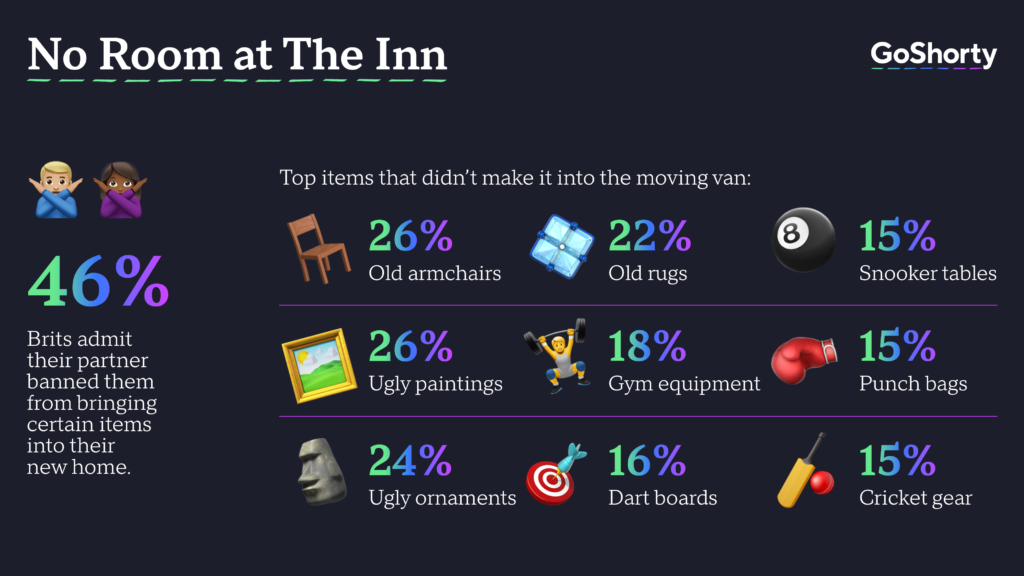
    When it comes to what you’re bringing into your new abode, four in ten (46%) admit they were banned from bringing certain items, while a tenth (seven%) said that their partner had the final word on what could and couldn’t be brought into the shared space. 

    Whether you’re planning to mount an attack on a particularly revolting sideboard before or after you’ve moved in doesn’t appear to make a great deal of difference – with a tenth (12%) of Brits continuing to argue about items long after the move in date.

    Some of the worst offenders for a lover’s tiff included…

    Commiserations to the men forced to give up more of their possessions (27%), compared to the women (22%). Clearly, when it comes to furnishing your first home, girl power reigns supreme.

    On average, cohabiting Brits have four van loads of belongings to move, with clothes (17%), kitchen equipment (14%), beds (14%) and sofas and armchairs (13%) causing the biggest arguments on moving day. Awkward. 

    The Best Way to Make the Move

    Andy Moody, Founder and Managing Director of GoShorty, said:

    “Gone are the days of ‘when you know, you know.’ It’s clear from our research that modern Brits are much more sensible than the old romantics, and need to put their partners through a 14 month testing period before taking the cohabitation plunge!

    “From our own data, we can see 7% of Brits use our temporary van insurance for moving house, for more than one day, and 17% are more likely to purchase a policy on a Saturday – giving them the whole weekend to pack, move and unpack again.

    “While the overall process of moving house can be a stressful time, ensuring you’re covered properly doesn’t have to be! Opting to borrow a van and move yourselves in can take some pressure off the experience, giving you more time and flexibility to ‘agree’ on what will make the move – and save you money along the way!

    “There’s no need for endless form filling, key swapping or designated pick-up times. Simply borrow a van and get covered with GoShorty, in under 90 seconds.”

    Our survey found that over half (54%) of couples turned to family and friends to help them with the move, while 29% did it all themselves. One in five (17%) hired a removal company – and undoubtedly paid a steep price to do so!

    Is It All Worth It?

    In short, yes! The vast majority of Brits (71%) said that moving in together benefited their relationship. Ah, young love. While a third (31%) reported arguing more now that they live under the same roof, the odds are still very much in Cupid’s favour.

    Whether you’re ready to take the leap of faith and move in with your partner or not, GoShorty has you covered whenever that day arrives. Borrowing a van to move in is a great way to shift all of your gear efficiently, and with our temporary van insurance you can make the move more easily than ever before. 

    *This research of 1,000 couples (2,000 people) who live together was commissioned by GoShorty and conducted by Perspectus Global in September 2023.

    Similar articles you might like

    • The Best Way to Get Insured for Delivery Work

      Having the right insurance in place for delivery work is essential. Whether you’re picking up a few shifts in the

      Read more

    • ,

      Introducing Our New Temporary Insurance App

      Our new temporary insurance app is here to make getting temporary insurance even quicker, simpler and smarter than ever before.

      Read more

    • Cloned Websites Warning: How to Stay Safe When Buying Insurance Online

      Spoofed websites are on the rise – and insurance providers, such as ourselves, are increasingly being targeted. These fake sites

      Read more

  5. Moving House Cheaply

    Comments Off on Moving House Cheaply

    You wouldn’t be blamed for feeling a little trepidatious about the prospect of moving house – not to mention the cost. Not only does it require a complete sort out of all the junk you’ve accrued (year 2 Maths exercise book, birthday cards from the nineties, a single baby shoe, etcetera) – it can also quickly become a logistical nightmare. 

    You’ll require at least one other person to help lift, load, rejig, cram and unpack all your stuff. You may or may not develop a repetitive strain injury depending on the number of books in your personal library. Total number of coats you thought you had? Triple it. 

    Whilst you’ll certainly learn a lot about yourself (and the all too human tendency to hoard), you’ll also be able to cull like you’ve never culled before. Your local charity shop will finally be able to remove the ‘stock wanted’ sign that’s been pride of place in the window for the past three years. The prospect of lugging everything up a flight of stairs works wonders for the indecisive amongst us.

    But what is needed to move the lucky items that survive the cull, in as few trips as possible? A moving van of course. And if like most, you don’t have a van of your own, but do know someone with one. Save yourself the hassle of hiring a van and use a temporary van insurance policy to borrow mates instead. Hopefully they will even help out with the move that way too! 

    Borrowing a Van versus Renting a Van

    Considering hiring a removal company? Think long and hard about whether you really want other people going through your stuff, or witnessing a tiff in the kitchen over an old spatula. Maybe removal services might just be a luxury you’re not ready to splash out on yet. Your next options are either renting a van or borrowing a friend’s and getting temporary van insurance. 

    Renting a van from one of the big rental companies, will typically take AGES and a metric tonne of paperwork before you’re able to drive away. They can also cost a fortune, depending on the size of the vehicle and the time period you require it for.

    This is where temporary van insurance comes in. No endless form-filling, key swaps, or designated pick up times. Simply borrow a mate’s van, get covered in under 90 seconds, and begin the house move in earnest – tiffs and all – without bankrupting yourself in the process.

    Moving Checklist

    Speed, ease, cost – the three preoccupations of every mover’s mind. Follow our handy guide to move speedily, easily, and cost-efficiently. See what we did there? 

    • Pack everything before you’re actually moving. Do you really need access to a nineteen step skincare routine the night before you move? Be brutal, be bold, be without your hyaluronic acid for one night. Get it packed away, so you’re ready to go first thing. 
    • Clear out the freezer. Donate any rogue Quorn products to next door and revel in the spotless gleam of your empty appliances. 
    • Being your own man with a van is likely the cheapest option for those looking to move house without spending a fortune contracting the services of a local removal company. We recommend dungarees, to really nail that moving day aesthetic.
    • Consider a cool box for the van you’re borrowing. Access to an ice-cold drink really improves a day of back-breaking labour, in our experience.
    • Don’t faff around renting an expensive van. Borrow your mate’s old banger, get insured for the day, and get moving. 

    See? Fast. Simple. Cheap.

    When’s Best To Move?

    We know from our own database that of those borrowing a van specifically to move house are: 

    • 10% more likely to take out 1 day insurance than those getting covered for other reasons, and 7.4% more likely to take out 2 days.
    • 31% less likely to take out 1 hour, and 35% less likely to take out 2 hours.
    • 17% more likely to buy insurance on Saturday and 18% less likely to buy on a Monday.

    Which is to say, we know you know that moving house takes at least a day – it’s a mammoth task – and a couple of hours simply won’t do it, we’re afraid. It’s also fairly clear that most of us do not want to spend our valuable holiday day allowance on the gruelling task of a house move – hence, weekend cover. 

    Your best bet? Clear your weekend, tell your mate not to expect the van back until Sunday, and get your heads down. 

    Don’t be scared of the Big Move. Take the opportunity to have a good sort out of all your stuff, borrow a van and get covered in minutes, and rope your friends and family in on the promise of a cold beer at the end of it all. Happy moving!

    Similar articles you might like

    • Everything You Need to Know About Drive-Away Car Insurance From GoShorty

      Drive-away insurance is a popular type of temporary insurance, but it’s understandable if you’re not entirely sure what it involves.

      Read more

    • Can I Tax a Car with Temporary Insurance?

      Ensuring your car is legally allowed on the road is essential. There are many things drivers need to consider to

      Read more

    • ,

      How to Help Your Friend Move to a New Flat

      Moving to a new house is an exciting time, but it can be hard work. Helping friends in need can

      Read more

  6. Borrowing a Van for an IKEA Trip

    Comments Off on Borrowing a Van for an IKEA Trip

    The UK’s love affair with IKEA shows no signs of abating. The Swedish retailer has become synonymous with affordable home improvements, functional furniture and delightful Scandinavian design. Whether you’re moving into a new place or revamping your existing one, a trip to IKEA is never far away. 

    However, the logistics of getting all your new fantastic furniture home can quickly turn a dream shopping spree into a delivery nightmare. If you don’t have a car you’ll soon be exploring transport options, like finding a van rental service, or whether to use the IKEA van hire delivery service.

    Why not just borrow a van for an hour or two? 

    Imagine strolling through the vast aisles of IKEA, gleefully adding items to your cart, knowing that getting them home won’t be an issue. Instead of stressing about how you’ll squeeze that towering bookshelf, those extra-long curtain rods and all the plants that you picked up on the way to the checkout into your tiny car – simply borrow a van and skip the delivery charge entirely. 

    With temporary van insurance from GoShorty, you can enjoy the benefits of borrowing a van – without the hassle of traditional van hire services. By using temporary van insurance, you’ll have access to a larger vehicle that can accommodate your purchases effortlessly.

    It’s as simple as getting a quote and obtaining temporary insurance cover for the duration you need.

    Borrowing a Van vs. Hiring a Van for an IKEA Trip

    Hiring a van can be a lot of hassle. From searching for the best quote, filling in endless forms and the lengthy wait to actually pick it up – it’s a process that adds unnecessary stress to the whole IKEA shopping journey.

    So, when it comes to planning your interior overhaul session, consider reaching out to friends or family members who own a van. You might even post a shout out to your local online group. People are generally happy to lend a helping hand – especially when it’s for a quick errand like an IKEA trip. (They may even want to join you to find their own bargain!)

    By utilising short term van insurance, you can ensure that both the borrowed van and your no claims coverage are protected during your trip. GoShorty offers flexible options, allowing you to extend your insurance coverage if needed – meaning you won’t have to rush back to return a hired van within a strict time limit, and removing any extra stress from the whole experience.

    You can take your time assembling your furniture and styling your space, all while enjoying the convenience of having a borrowed van at your disposal – particularly useful if you’ve forgotten to pick up any important parts!

    Borrowing a van for an IKEA trip is a game-changer. No stress over delivery fees, tiny cars or convoluted hire processes. With a quick van insurance quote from GoShorty, the process is speedy, hassle-free, and cost-effective. 

    Say goodbye to worrying about your next trip to IKEA and embrace a simpler, more efficient way to transport your furniture. Visit our temporary van insurance page for a quote from GoShorty today.


  7. How to Get Rid of Unwanted Furniture

    Leave a Comment

    If you’d like to change the look of your home, are planning to move, or are sizing up or down, there’s likely some furniture and other items you’re not taking with you or that aren’t serving you any longer.

    But what can you do with unwanted furniture that’s still in good condition and other household waste?

    In this guide, we’ll explain all of the different options for getting rid of furniture in a creative and hassle-free way, from searching for buyers to moving it using short term car insurance.

    Consider restoring or upcycling your furniture 

    If you want to renovate your home, an easy and cheap way to do so is to give new life to your old furniture by restoring it. You can paint your wooden furniture in different colours or replace doors and handles with more modern options.

    Recycling or trying to repurpose your old furniture is a great option too. Upcycling old items has become a big trend in recent years, and there are many incredible inspirations to give your furniture a stylish new look.

    For instance, you can give an old sofa an entirely new look by just stripping the upholstery and changing it for a new, more stylish fabric.

    Upcycling is also a more environmentally friendly way to repurpose old furniture. It saves carbon emissions by reducing waste as you are not throwing away anything or buying new items.

    If you have any wood left over from old chairs or a table, you could also donate these furniture items to local businesses or people you know.

    Hold a sale

    An easy and fun way to get rid of old and unwanted furniture is by having a sale where all your neighbours and local collectors can come by and look at your old furniture. This is also a good way to have a say over the price of your old sofas, beds and other items, and you might get some good money for your old furniture.

    Another possibility is to attend a car boot sale or take your furniture to a local market.

    Some people might also be interested in trading your old furniture for some of their own, which can be a fun and inexpensive way to explore new items for your home!

    More ways to get rid of furniture without selling it include offering it to a friend or a family member who is just starting out or has some emotional attachment to the item. This way, you might still be able to sit on your old sofa once again, and it’s a lovely way to give your items a second life!

    Advertise furniture online

    Another effortless way of getting rid of unwanted furniture is to advertise pieces online. This way you can reach a broader audience that might be interested in your furniture. Facebook Marketplace is a brilliant option for this.

    Just because you don’t like or want a piece of furniture any longer, doesn’t mean it can’t be of good use to someone else!

    You can set the price you wish to sell your items for on Facebook, Gumtree or even eBay. Or, you could offer them online for free on other websites such as Freegle.

    Similarly, you can use these platforms to find new furniture online for yourself as well. There’s not always a need to buy new!

    Donate your furniture 

    Donating them to charity might be a quick solution if you don’t have the time to upload all your items to an online platform or organise a  sale.

    Several charitable organisations in the UK will accept furniture donations, such as the British Heart Foundation.

    A local charity selling or giving away old furniture should let you bring your items to a drop-off location and then take them from there.

    Other organisations might even offer to pick up your bulky items for a small fee if you want to get rid of anything quickly.

    If you have any smaller items, you could also take them to a scrap dealer.

    However, you should be aware that some organisations require to see your furniture items first and ensure that they meet safety regulations and other requirements.

    Mattresses are always a complicated item to get rid of, and, understandably, most people don’t want a used mattress for their bed for hygiene reasons. However, many charitable organisations, animal shelters and humane societies might be interested in taking your old mattress.

    Another easy way to get rid of your furniture is to put the items in front of your house with a “free” sign. You would be surprised how many people are happy to see a chair or vase in good condition and will make a plan to take it home in no time!

    Throwing away old furniture

    However, sometimes none of the above is an option, and the only way to get rid of a furniture item is by throwing it away. It could be that your items are unusable or damaged beyond repair.

    You can contact your local waste collection services or find the nearest furniture disposal place for any unwanted furniture that can’t be saved or salvaged any longer. This is also a good idea for things like old mattresses.

    Always make sure to check the details of your local waste and recycling centre as each has different guidelines on what you can and can’t bring.

    Transporting your items

    No matter which option you choose, you’ll likely need to transport your furniture safely in some kind of way. Hiring private waste or furniture collection services can be very pricey. A far more affordable and handy option is to ask a family member or a friend if they have a van you could borrow.

    Another option is to rent a van for several hours, which can still be cheaper than having your furniture picked up by a company at your home. Temporary van insurance is a great way to make sure you’re ensured while you transport any unwanted items.

    Most van rental services offer the option to book online, making it all the more convenient.

    Consider short term vehicle insurance from GoShorty

    To ensure you are fully covered against accidents or damage when driving your van or car to transport your furniture, you should consider short term vehicle insurance.

    GoShorty is a quick and easy option for this. It only takes a couple of minutes to go online to arrange a temporary car insurance quote or purchase fully comprehensive insurance for the time you use the vehicle.

    Remember to get dedicated temporary learner driver insurance if the person driving the van hasn’t passed their test yet.